
This year, I read/listened to the most books I can remember (outside of my years studying for my doctorate). Starting last year, I utilized many resources through our local library and the Libby and Hoopla apps. I like to tease my wife when we get our local tax bill, and I see the library tax listed, “It looks like I’ve got to read $78 worth of books from the library this year!” These library apps have been amazing! When I’m on the road, remodeling our house (listened to a ton this summer), taking a break from work, or walking alone in our neighborhood, I typically have an audiobook playing through my Airpods at 1.5 speed. I got my money’s worth this year.
As we prepared to move this year, I donated two carloads of books to a Bible college and sold eight U-Haul boxes of books to McKay’s Used Books in Nashville. I still have a ton of print books on our shelves! I started buying almost all my books in digital form. I use the Logos platform and Kindle. My son bought me a Kindle Scribe for my birthday this year. I love it! I enjoy its size and the ability to handwrite sticky notes. These can be viewed on my phone, iPad, and laptop.
This year, I’d like to highlight five of the books I enjoyed and one I would not recommend. (Disclaimer: This is not meant to be a scholarly review of these works. I’m simply giving my insights, a little commentary, and what I learned from each book.)
Brothers, We Are Not Professionals, John Piper

This book1 is the updated and revised version from 2013. The first time I read it was in seminary, probably in 2005. The update on Brothers was terrific! I love this updated preface!
And I conclude this new preface with the same prayer I began with: “Banish professionalism from our midst, O God, and in its place put passionate prayer, poverty of spirit, hunger for God, rigorous study of holy things, white-hot devotion to Jesus Christ, utter indifference to all material gain, and unremitting labor to rescue the perishing, perfect the saints, and glorify our sovereign Lord. In Jesus’ great and powerful name. Amen.”2
It came with fresh insight and the ever-caring and thoughtful prose from John Piper. I picked this book mainly because it was the last book I went through with a group of pastor friends from West Kentucky before I moved. It brings back memories of a group of guys who met monthly, opened their hearts to one another, struggled with thoughts and ideas presented in many books we discussed, and openly questioned things you don’t often hear pastors asking within the walls of a church.
Brothers was an excellent example of our time together. Some of Piper’s ideas were openly criticized within our group. One brother thought Piper could have made the book into a booklet (why does he use so many words to say what I can say in a paragraph?), and another brother openly shared his struggles as he led through transition. I miss that group and feel tears forming as I write this sentence. Find a book like Brothers and a group of like-minded men or women. You’ll thank me.
Total Forgiveness, RT Kendall
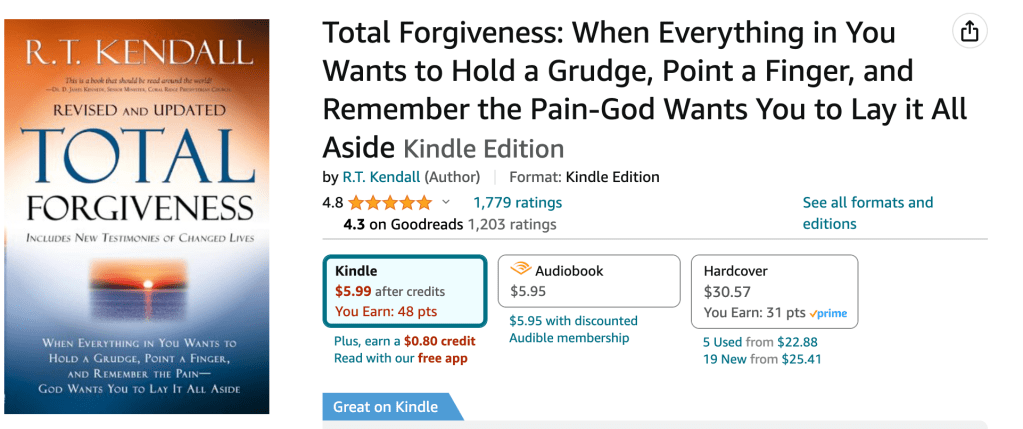
I love reading Dr. Kendall. Born in Ashland, Kentucky, Dr. Kendall followed Martyn Lloyd-Jones at Westminster Chapel in London. Imagine that: a Kentucky boy preaching and pastoring a church in England! These sentences transformed me and helped me through a tough time this year:
When you forgive someone, you are set free from a type of emotional bondage. — the Lord seemed to say, what if I forgive you in the proportion you forgive others? — forgiving someone does not mean we will take a vacation with them, but it does mean we will read our hearts of all bitterness toward them. —Col 3:13
Total Forgiveness reminded me that forgiveness is a process. While I was struggling through forgiving others, Kendall encouraged me to ask the Lord to consciously change my heart daily. I began to spend more time in prayer, become more gracious with others, and not allow the sins or sins of others to control me (more on this with Safe People, by Cloud).
I’ve met a handful of people who remind me of what Barnabas would be like today. Kendall reminds me of these people. I’ve teased friends and said, “When I grow up, I want to be like you!” This past year, I thought, “That’s crazy! I’m doing that right now!” I like to learn from people like RT, my friend Benny in Kentucky, and Eric in Oklahoma. These guys genuinely exhibit a Barnabas-like attitude of constant encouragement. RT is now 88 years old and takes to social media almost daily with a short devotion or motivation for others. I think Barnabas would be doing something like that today!
Safe People, Henry Cloud

Safe People was one of those books I borrowed from my local library. It put into words what I’d been thinking over the past several years. Some people aren’t safe to:
- Be around. Simply being around them makes you feel poorly about yourself. When you go home, you find yourself venting about this person. Then you have to repent of doing that. What a cycle!
- Trust. Unsafe people will make you think you can trust them but will use whatever you’ve shared with them against you whenever it’s convenient for them. “Oh, they’ve changed! They aren’t like that anymore!” Then you trust them and learn the hard way…again.
- Be led by. Unsafe people make some of the worst leaders. You second-guess yourself all the time. You never feel like you are doing a good job. You are hindered professionally rather than taking that time to grow.
- Lead. Unsafe people are hard to lead. They bring others around them down. They make a job take twice as long. They make you wish the project was over before it starts.
What did I learn from Cloud?
- I need to recognize who is safe and learn from them.
- Some people are more challenging to love, so I must carefully open up to them and show kindness and grace without hurting myself. Sometimes we can take things too personally.
- Some people make it impossible to want to have a meaningful relationship. Maybe some hurt from the past causes them to want to destroy/hurt everyone around them. Maybe there’s a current sin issue that they are not dealing with that is the problem. Perhaps they’ve never been told how hurtful their words/actions are and need someone to lovingly tell them. And finally, in the words of Michael Caine from The Dark Knight, “Some people just want to watch the world burn.”3
- The unsafe person doesn’t define who I am or get to dictate my thoughts or actions.
Kendall and Cloud have been incredible in helping me to remember that my identity is in Christ. He helps me love those who I struggle to love. These books have reminded me to place healthy boundaries around those who tend to hurt rather than support and spend most of my time with Safe rather than Unsafe people.
Bully Pulpit, Michael Kruger
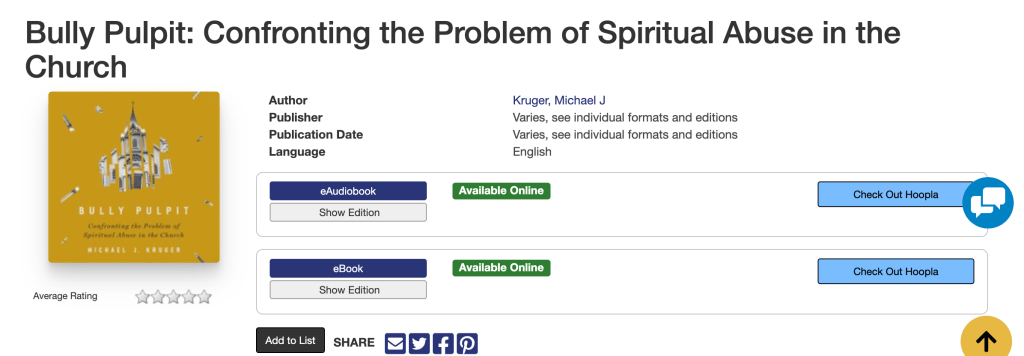
Last year, I read A Church Called Tov by Scot McKnight. Bully Pulpit runs within the same topic. I recommend this book to every Christian, especially church staff and members who may need to recognize an abusive leader.
If you find yourself in a church with an abusive leader and the other leaders don’t want to do anything about it, please leave and find a church where this is not happening.
Kruger provides a readable and relatable account of the characteristics of an abusive leader, how to biblically deal with one, and how to protect yourself and those you love from this type of person.
If you are dealing with pain, confusion, depression, and other unhealthy emotions from a Bully leader or church, this book can help you put words to what you are feeling and support you as you heal. I recommended Bully to another believer, and she said, “I knew something was wrong at my last church, but I didn’t know exactly how to word it. This book helped me see that I was in a church with an unhealthy leader. I thought I could help change them, but now I know I should have left sooner.”
All My Knotted Up Life, Beth Moore
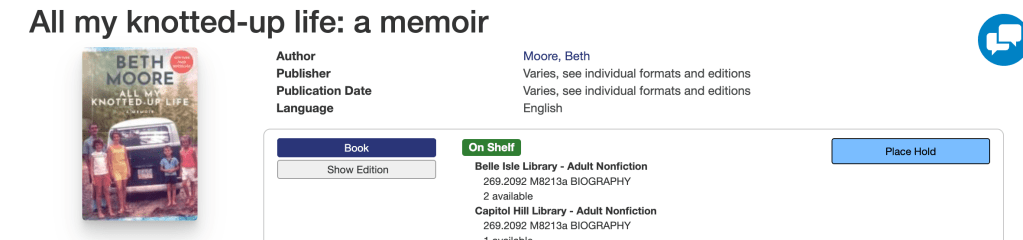
All Knotted is the first book I’ve ever read by Moore. I have read plenty of opinions through social media, seen her books in our church library over 20 years ago, and know some people who have gone through her studies. My main takeaway from reading All My Knotted was to learn about the person and their story before buying everything you hear or read. I honestly can’t tell you if she’s an anointed Bible expositor, but from what I’ve read in this book, I can honestly say that Moore has a hunger for the Lord that is safe to emulate.
As I read, I was reminded that each person has a backstory that I’ll likely know nothing about. Moore recounts early childhood abuse that no child should endure. She brings the reader along as she walks with the Lord, from a young girl learning to love the Bible to a young woman challenged to grow in her gifts. She recounts the joy she feels as women using her material are growing in their relationship with the Lord and are learning to have a desire to feed themselves through daily Bible reading, study, and prayer. I was honestly saddened and hurt by two things she described toward the end of the book.
- She needed to take to social media when she was getting attacked. I’m always sad when I see leaders headed straight for SM to say the first thing on their mind during an attack. She admits her response to the criticism was inappropriate and that she had no idea what was coming after she posted it to Twitter. Hindsight is 20/20. How many times have I wanted to comment, reply to a comment, or repost something that I knew might be seen as aggressive? A lot. (Remember a previous post where I want to say, “Calm down guy!” but I don’t?) Social media has become a place where we can pop off real quick, get a dopamine hit, troll other’s fake lives, or even live vicariously through another’s presentation of their life. I recently read John Crist’s book Delete That. He describes the feelings of validation in taking to SM to receive value or justify ourselves. I was reminded (again) by Moore that this plan is seldom a good one.
- Christians openly attacking one another. She describes being verbally attacked by seminary students, pastors, and even denominational leaders. I was almost in tears, not by her description of the attacks, but by thinking about how we’ve normalized actively “coming at” other believers when a secondary/tertiary belief is different from ours. We take to SM using Matthew 18 as a pretext when we don’t know the person, will never meet them, and probably wouldn’t talk to them if we were in the same room. The discernment leaders are not helping. I used to listen to a few on YouTube/Podcasts, but now my heart hurts for them AND their listeners. There is a place and a way to do this, but how we see it being done today (for the most part) is not the way.
Moore and her husband have found a home in the Anglican Church in TN. While I’m not planning on joining them, I’m happy they have found a believing community that loves them and a place where they can heal and grow closer to one another and the Lord.
Surprise the World, Michael Frost
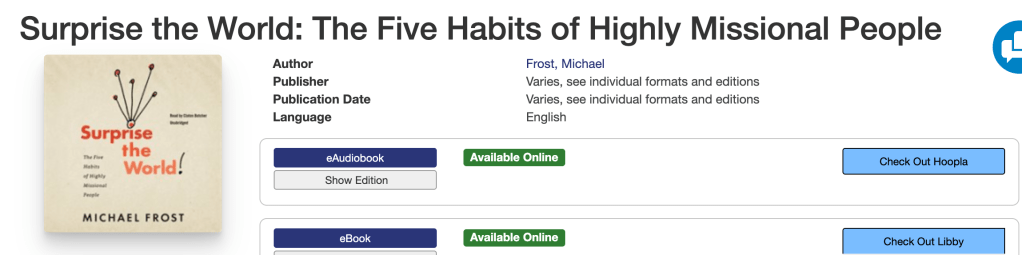
Surprise surprised me! I was unprepared for Frost’s vehement disagreement with a forward evangelistic methodology. In summary, he says not all are evangelists, so all should not be expected to evangelize in the same manner as those exceptionally gifted. Well…
Surprise spent too much time telling believers why they shouldn’t share the gospel. Frost is reacting to too many sermons where pastors make people feel guilty for not evangelizing. I think he is right here. I think I’ve done that and repent of it. Believers need encouragement, equipping, and the opportunity to share with an experienced evangelist. What they don’t need is a guilt trip.
Evangelism is one of those disciplines that needs to be kept in front of the church, not diminished, downplayed, or discouraged. Each believer has been placed within a context and given gifts that allow them to share a biblical gospel in love, kindness, and boldness. Some are gifted evangelists who think, dream, and act evangelistically. My friends Kenny, Matt, Scott, and Susan are like this. They effectively use their gifting to teach and lead in love. Those they lead are, in turn, encouraged to share more often. While I will not recommend Surprise to others, I will be reminded that not everyone is a gifted evangelist.
What are a few books you’ve enjoyed in 2023? What are you looking forward to reading in 2024?
- Photo courtesy of http://www.desiringgod.org. ↩︎
- Piper, John. Brothers, We Are Not Professionals (p. 8). B&H Publishing Group. Kindle Edition.
↩︎ - https://www.youtube.com/watch?v=SIYkhb2NjfE. ↩︎
 Toby DeHay